01
What is the story behind the ISKCON Bangalore case?
In 1965, an elderly sannyasi crossed an ocean with forty rupees and a trunk of books — and lit a movement that circled the world. On a rocky hill in Bangalore, his followers raised a temple to his Lord. This is the story of that hill: of the instruction the founder left behind, of the devotees who would not let it be set aside, of everything it cost them — and of the day the highest court in India spoke.
The founder’s instruction.
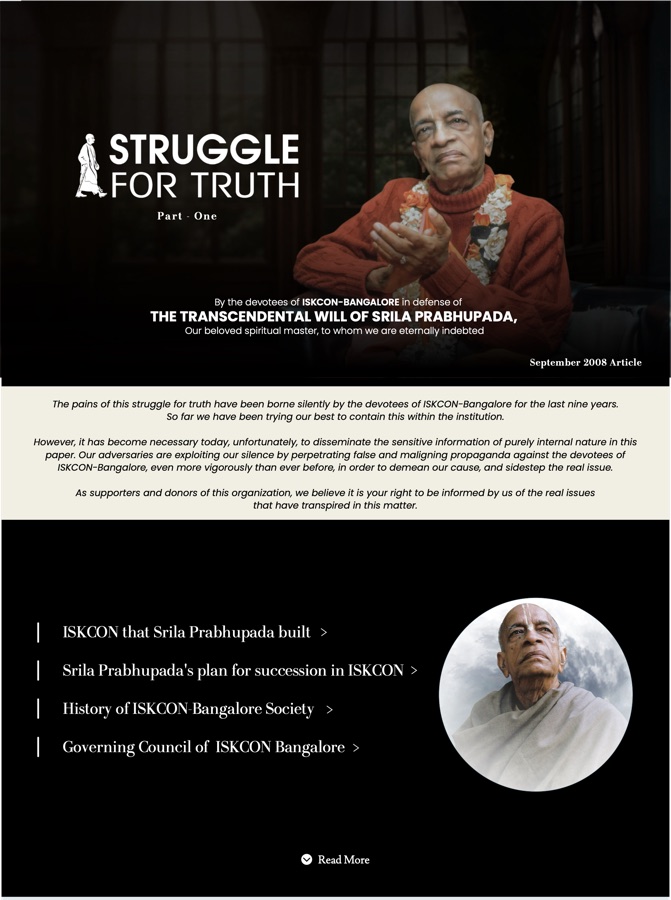
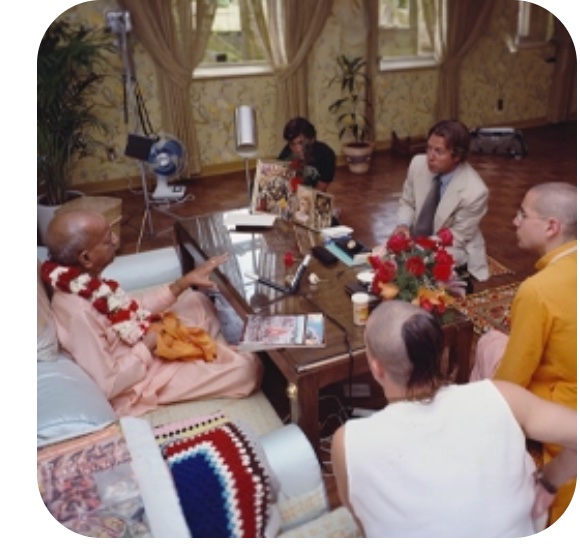
ISKCON’s founder, His Divine Grace A.C. Bhaktivedanta Swami Srila Prabhupada, built a worldwide movement in eleven years. On July 9, 1977 — four months before his passing — he issued a written institutional directive on how initiations were to be conducted thereafter: through ritviks, officiating representatives, with new devotees becoming his disciples. After his passing, the movement’s governing body adopted a different system — of successor gurus. Whether the founder’s written directive should instead be followed became the deepest question inside the movement. It is the question beneath everything that follows.
The directive of 09.07.1977 · addressed in GBC resolutions 301–302 of 1999
A society, and a hill.
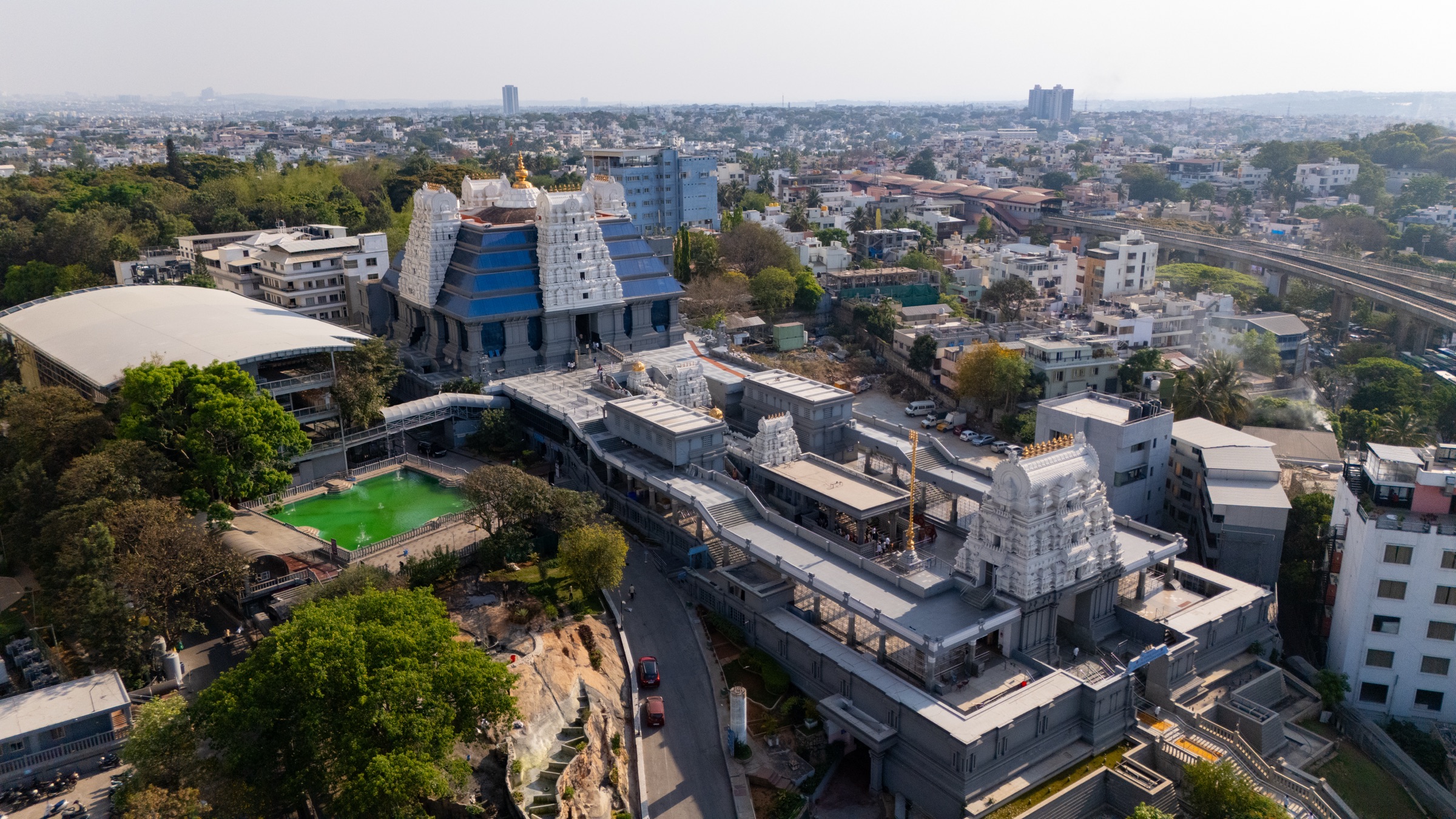
In 1978, devotees in Bangalore registered a society under the Karnataka Societies Registration Act — the International Society for Krishna Consciousness, Bangalore (Reg. 49/78-79). In 1987 the society applied to the Bangalore Development Authority for a rocky hill in Rajajinagar; in 1988 the BDA executed a registered sale deed in its favour. On that hill the devotees raised the Sri Radha Krishnachandra temple, inaugurated in 1997 — today among the most visited Krishna temples in the world.
¶¶47–51 · verify
The stand, and the price.
In 1998, devotees in Bangalore came across the text of the founder’s directive of July 9, 1977. Its words are plain: the eleven senior disciples named in it were to act as ritviks — representatives of the Acharya — and “the newly initiated devotees are disciples of His Divine Grace A. C. Bhaktivedanta Swami Prabhupada.” Yet for two decades the movement had practised something else. Soon after the founder’s passing, the ritviks had declared themselves successor acharyas; new devotees became their disciples, not his; and in time the movement’s own law came to prohibit a devotee from accepting Srila Prabhupada as his initiating spiritual master — the very thing the directive provides.
Sri Madhu Pandit Dasa — president of the Bangalore temple, which he had spent over a decade building, and himself a disciple within that system — took his questions first to his own spiritual authorities. The answers he received did not address the document. So he took the document itself to the top: on February 9, 1999, he appeared before the Governing Body Commission’s plenary session, alongside the president and vice-president of the Calcutta temple, and made one argument — that the founder’s written directive on initiations must be followed, and new devotees initiated as Srila Prabhupada’s disciples, through representatives, exactly as the letter says.
The answer came as Resolution 302 of 1999: he and his associates were “deemed as UNFIT to be members of ISKCON India.” In plain language, he was expelled — for asking that the founder’s written instruction be obeyed. At the time, he was among the most prominent temple presidents in the movement, with a plausible path to its highest bodies. He set that aside over this one question.
GBC resolutions 301–302 of 1999 · read the July 9, 1977 directive in full
The lawsuits begin — and the allegations.
The expulsion was followed by moves to take control of the Hare Krishna Hill temple. ISKCON Bangalore went to court to protect its possession — the suits that became Suit No. 7934 of 2001 and Suit No. 1758 of 2003. With the litigation came the allegations, repeated in and out of court for the next two decades: that the society’s land records were forged, that its 1984 general body meeting was fabricated, that its president had manipulated documents and accounts. Those allegations — and what every court made of them — are examined one by one in section 04.
¶1 · verify
The first verdict.
After years of evidence — the allotment application, the sale deed, the certified meeting records, the witnesses — the City Civil Court, Bangalore decreed the suit on April 17, 2009: the temple and its properties belong to ISKCON Bangalore. The challengers, the court found, had produced no evidence for their case.
Decree of 17.04.2009 · upheld at ¶70 · verify
Reversal, and the long cloud.
In 2011 the Karnataka High Court reversed the decree — and, along the way, recorded findings against individuals that the Supreme Court would later hold “were not warranted at all.” ISKCON Bangalore appealed. On June 6, 2011 the Supreme Court ordered status quo, and expressed “a pious hope” that the parties would resolve the matter amicably. For the next fourteen years, the devotees served under an undecided case — and an undimmed campaign of allegation.
RFA 421/2009 · SLP 15814/2011 · status quo order of 06.06.2011
The peace that was offered.
Following the Court’s nudge, both societies entered mediation before Justice R.V. Raveendran, a retired judge of the Supreme Court. Round after round through 2012 and 2013, ISKCON Bangalore accepted every material demand put to it — control of the temple, ownership of the properties, even the resignation of its own leadership, Madhu Pandit Dasa included. It asked one thing in return: that in these temples, Srila Prabhupada alone be revered as the initiating guru, per his directive of July 9, 1977. That single condition was refused each time — the movement’s governing body instead offered to make senior Bangalore devotees initiating gurus themselves, an offer they declined. The mediation closed with the Supreme Court-appointed oversight committee recording that settlement failed on “a theosophical issue.” The property was never the obstacle.
The attempts did not stop there. In a settlement proposal of October 9, 2014, ISKCON Bangalore offered to place under ISKCON Mumbai’s ownership not only the Hare Krishna Hill temple but its flagship projects worth hundreds of crores — on the same solitary condition. That mediation happened, and that offers were made, was acknowledged by senior counsel for both sides in open court on December 3, 2025.
Acknowledged in open court · 03.12.2025 · see the transcript · the offers, in full
While the case dragged on.
The same years tell a parallel story. In 2001, ISKCON Bangalore constituted The Akshaya Patra Foundation under Madhu Pandit Dasa’s chairmanship; it grew into the world’s largest NGO-run school meal programme, past five billion meals served. In 2016, the President of India conferred on him the Padma Shri, one of the nation’s highest civilian honours. The decades of allegation were, in the same breath, decades of service.
Trust deed · 16.10.2001 · Akshaya Patra
Vindication.
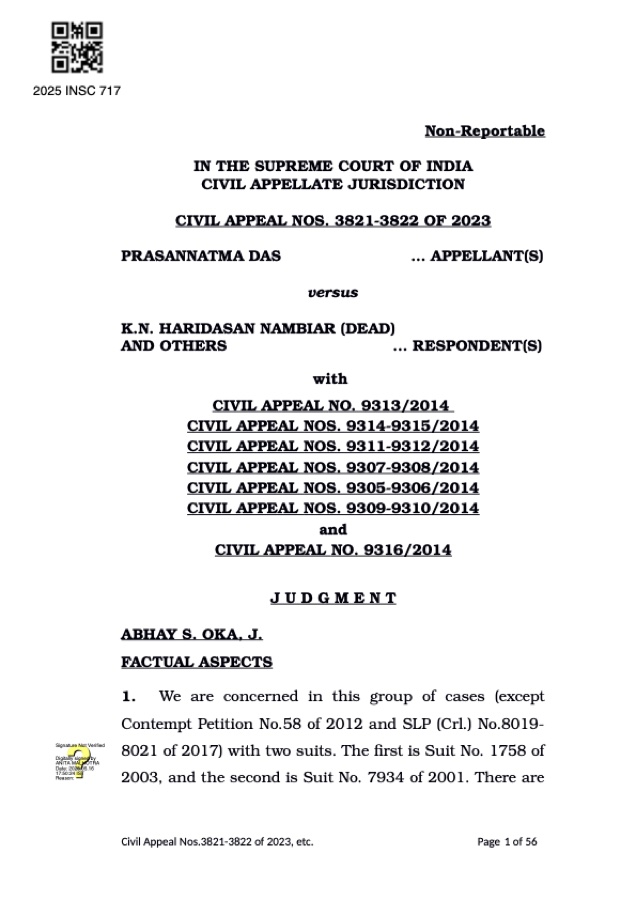
On May 16, 2025, a bench of Justice Abhay S. Oka and Justice Augustine George Masih ended the property question. The Supreme Court found the land record “crystal clear” in ISKCON Bangalore’s favour; held that the High Court’s findings against individuals “were not warranted at all”; found “no error” in the courts that had accepted the 1984 meeting as genuine; and quashed the FIR against the ISKCON Bangalore leadership. Every allegation that had pursued Madhu Pandit Dasa through the courts for twenty-five years failed. After the victory, the offer of peace was renewed — on the same single condition. It was again not taken up.
¶¶57, 58, 70, 71 · verify
Where it stands.
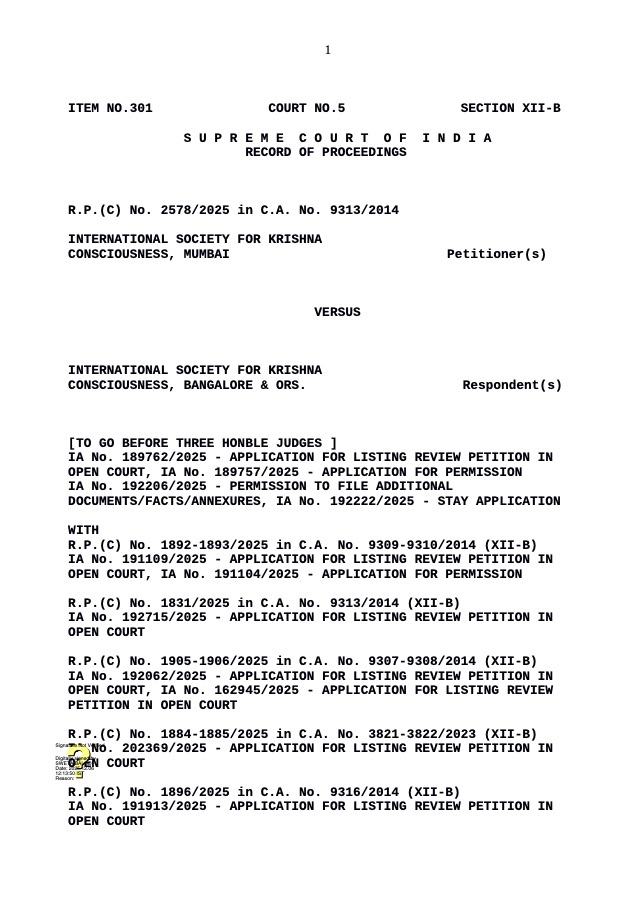
A review petition by ISKCON Mumbai is pending before the Supreme Court — a narrow remedy, not a rehearing, and one judge has already recorded that he found “no error apparent on the face of record” in the judgment. No stay has been granted; the temple stands decreed to ISKCON Bangalore today. Every order in the review petition, the complete December 3, 2025 record, and every document behind this story are published across this site — so you can verify each line of it yourself.